
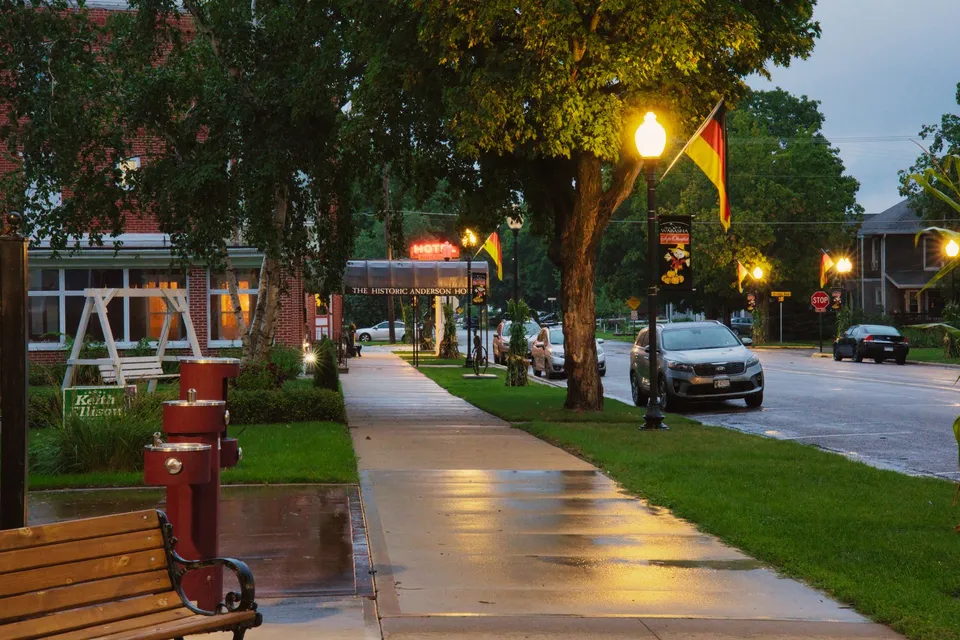
Grand Rapids, Minnesota, is easy to confuse with Grand Rapids, Michigan, but the local decision is much smaller and more practical: where do you work, how do you get there, and what does the rest of the day need to look like? In the city of 11,181, the average commute is 15.0 minutes, yet that number hides the real question for newcomers: whether your worksite, housing, school needs, and shift schedule can all fit inside the same daily route.
Grand Rapids has more than one work center
The strongest pattern in Grand Rapids is not one single downtown. It is a set of work clusters. The city’s planning materials describe downtown mixed use, a medical campus, and industrial areas as separate parts of the land-use map, which is another way of saying that a receptionist, a mechanic, a clinic aide, and a public-works worker may all have very different commutes even if they all say they work in Grand Rapids.
That matters because the local economy is built around institutions, not just storefronts. Grand Itasca Clinic & Hospital operates as a 45-bed hospital with a 24-hour emergency department, a rapid clinic, and a wide specialty mix that includes family medicine, imaging, home care, surgery, therapy, cancer care, and mental health. Those services create jobs in clinical care, registration, records, maintenance, food service, and support work, not just in nursing.
The county’s transportation department adds another layer. Itasca County is responsible for roughly 1,350 miles of roadway and 140 bridges, so road work, equipment operation, signing, drainage, snow removal, and bridge maintenance are not abstract public jobs here; they are part of the region’s daily functioning. If you are coming from outside the area, that is a useful reminder that transportation and public works are not side notes in Grand Rapids. They are part of the employer base.
Transit helps, but only if the schedule fits your shift
Grand Rapids is compact enough to support a real transit choice, but the choice is not automatic. Arrowhead Transit’s Grand Rapids Dial-A-Ride operates within city limits and posts weekday, Saturday, and Sunday service, with fares that include a $3 one-way ride and a $54 unlimited monthly pass. The county route system also connects Grand Rapids with nearby places such as Cohasset, Deer River, Warba, Bovey, Calumet, Marble, Nashwauk, and others. That means the region is connected, but it is not one simple commute shed.
For a job seeker, that has a direct consequence: a first-shift role that starts early downtown may be a different proposition from a second-shift role at a highway campus or an outlying site. Transit exists, but you should match it to the exact worksite and hours rather than assume any Grand Rapids address will fit any Grand Rapids opening. The local route network is useful, yet it still rewards planning.
Housing is local, not generic
Grand Rapids looks affordable or expensive only when you ask the right question. QuickFacts estimates the city’s median gross rent at $1,090, median owner value at $213,800, median monthly owner cost with a mortgage at $1,431, and the owner-occupied rate at 62.4 percent. Those are useful anchors, but they are not a promise about any one apartment, house, or neighborhood.
The bigger lesson is geographic. Grand Rapids is the hub, but nearby communities such as Cohasset, La Prairie, Coleraine, Bovey, and Deer River each sit in a different relationship to schools, services, and commute patterns. A place that works well for a daytime job in the city may not feel equally convenient for an early shift, a late shift, or a household that relies on school pickup and evening appointments. In other words, the right housing choice is not just about rent. It is about how much of your life can stay on one side of the map.
Families should read school and training options as part of the offer
For households with children, Grand Rapids Area Schools is not a small side issue. The district says it serves about 4,000 students and offers programs from birth through adulthood, including early childhood services, a virtual academy, and an Ojibwe Education Program that has served children of native descent since 1974. That tells relocating families something important: the school system is broad enough to shape where people choose to live, not just where they enroll after moving.
Training matters just as much. Minnesota North College’s Itasca campus offers housing, dining, basic needs support, clubs, tutoring, adult basic education, career exploration, and fitness resources. For a newcomer, that means the campus is more than a classroom site; it is part of the support system for students, workers, and households trying to settle in without a long drive for every need.
That broader support network is one reason Grand Rapids works for people who are moving here for work rather than just visiting. Utility service, schooling, transit, and training all show up in the ordinary business of living. Grand Rapids Public Utilities, for example, serves the city and surrounding areas with electric, water, and wastewater functions, which is the kind of practical infrastructure that becomes obvious only after you move.
The real test is whether the whole day fits
If you are evaluating a Grand Rapids offer, read it like a map. Ask where the worksite is, whether the shift lines up with transit, whether your household needs are in the same service zone, and whether your housing choice fits the rest of the week, not just Monday morning. That is the difference between a job that looks fine on paper and a move that actually works in daily life. For more local orientation, start with the site’s resources page before you commit to the next step.